Four-bar lift competition robot
Check It Out: the MAE Smart Lockers contest. The project that inspired me.
Two robots, sixty seconds, head to head. Each has to pull objects out of a locker (Lego bricks, a wrench, a gearbox, a camera, a multimeter, an iPad) and deliver them to scoring spots: the dorm floor, a trolley track, inside a trolley, or one of three floors of a model Geisel Library. The higher and harder the spot, the more points; Geisel’s top floor, 15 inches up, pays the most. Robots start inside a 10 × 10 × 10 inch box and are built only from the kit (acrylic, aluminum, six small DC motors, springs, string) plus up to 50 cubic inches of 3D-printed parts.
Team “Actually 4Bar”: Jin Noh, Ruochen Li, Grace Liu and Alex Lu.
Aim high, not the middle
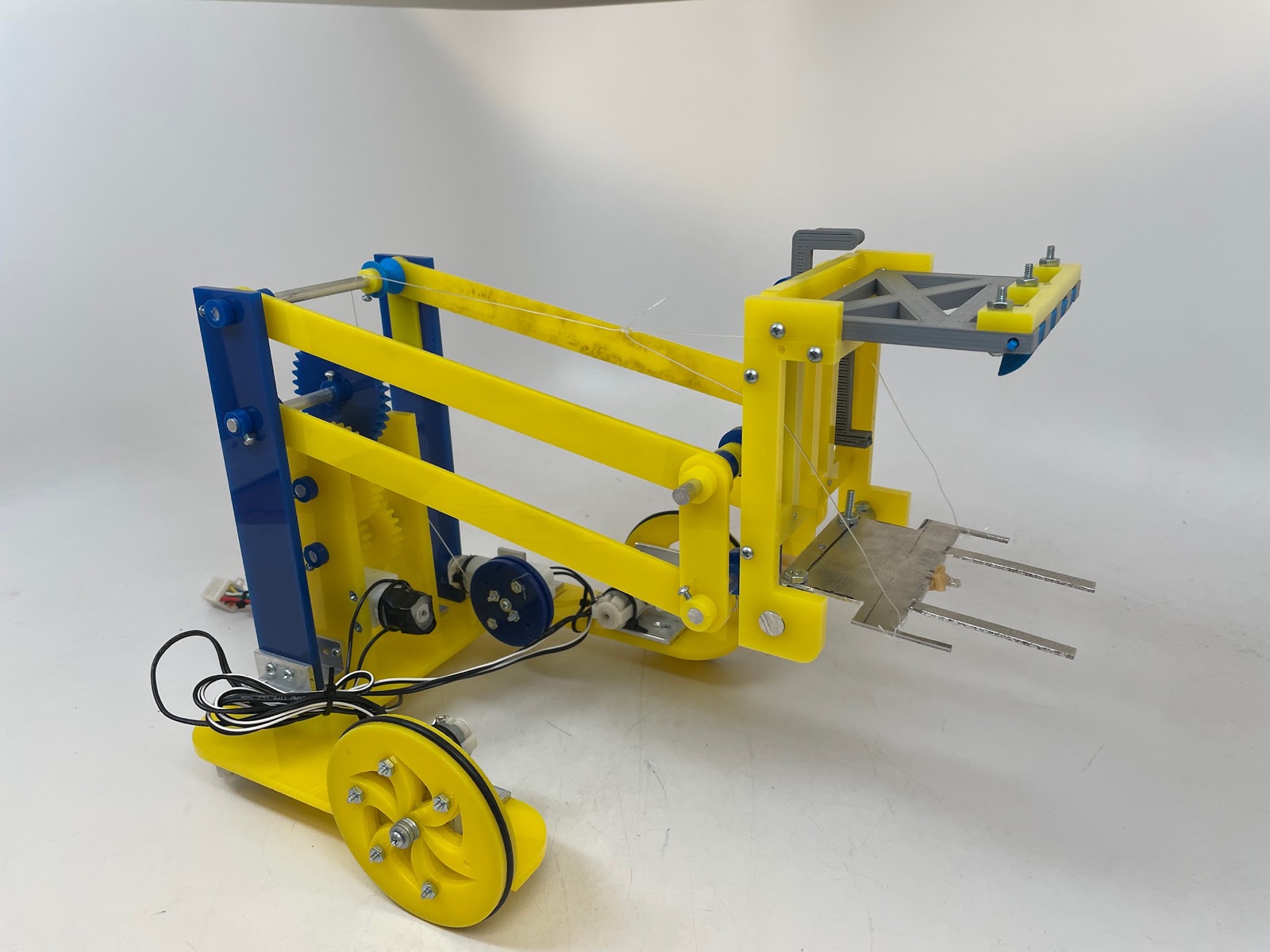
Our strategy was to reach the top of Geisel and take everything except the iPad Pro, with a robot that stayed easy to drive. That led to:
- A four-bar linkage lift. Simple, fast, and it reaches high. The final bars are 10 inches long.
- A 15:1 gearbox. Laser-cut acrylic gears glued into compound stages on ¼-inch aluminum shafts in aluminum brackets, multiplying the geared motor’s 0.32 N·m stall torque to roughly 4.8 N·m at the lift.
- A two-wheel front drivetrain with a Delrin skid for balance: a small turning radius, and it leaves room for the lift.
- A folding claw. A top plate with “fangs” drags an object out of the locker onto a forklift, a fishing-line pulley raises the bottom plate, and the fork tilts down to release. The claw folds to within 2 inches at rest so the robot fits the starting box, and a trigger drops it open at the start.
My part: proving the lift would work
Each of us owned a risk-reduction test. Mine was the four-bar lift, with two questions to answer before we committed: could it reach Geisel’s top floor, and could it lift the heaviest object, 130 g?
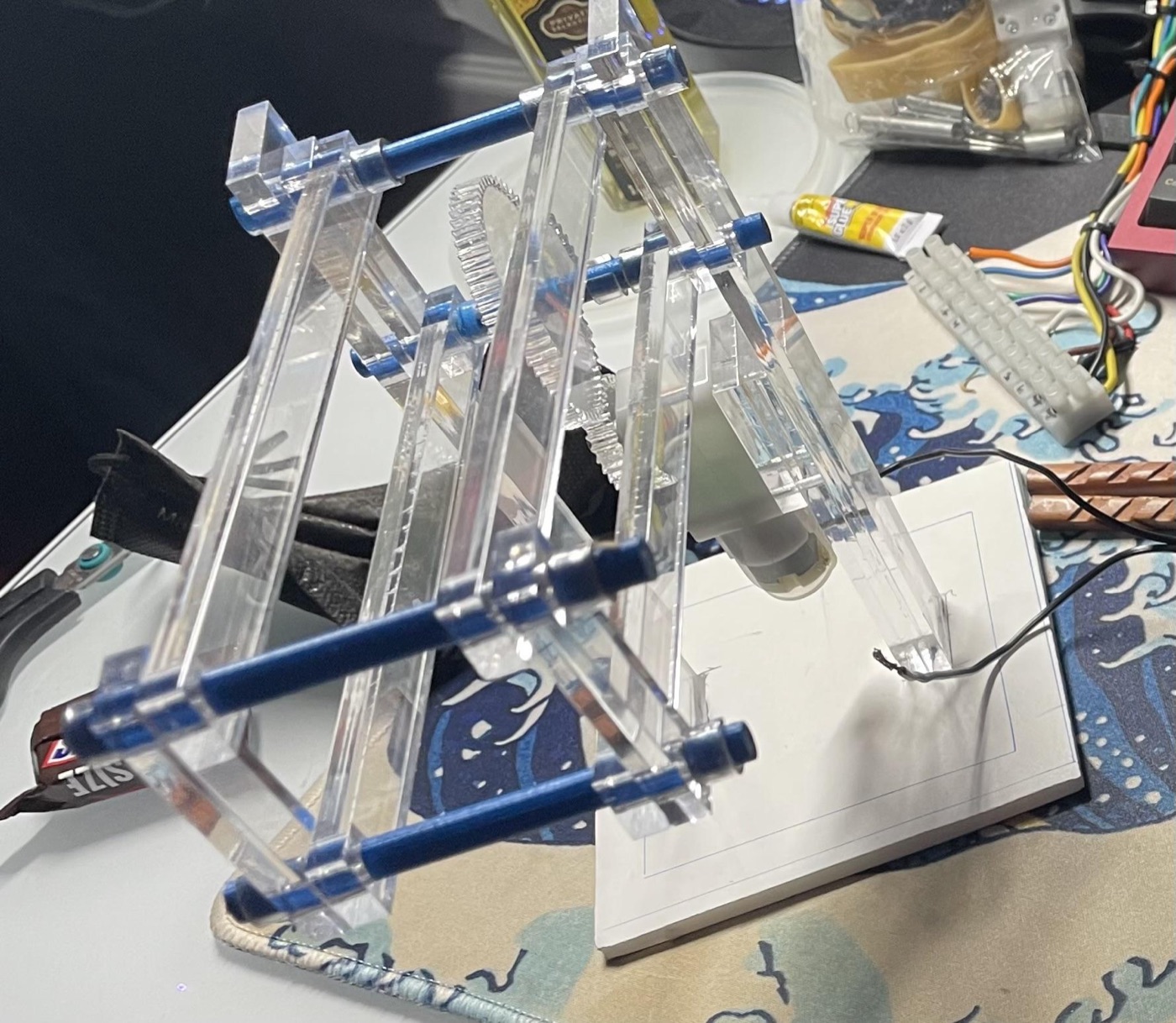
The first prototype answered no to both. Its gears slipped, it lifted 70 g at most, it wobbled in motion, and it came up short of the top floor. What it taught us shaped the final lift:
- 6-pitch gears instead of 12-pitch, for more torque and no slipping.
- A torque analysis to choose the gear ratio, rather than guessing.
- Aluminum brackets for a firm foundation.
- Longer bars, 6 inches to 10, to reach the top of Geisel.
Across the quarter I also worked on the design in Fusion 360 and on fabrication: laser cutting, 3D printing and machining.
Gear ratio, on paper and on the bench
With the lift horizontal and the motor stalled, the arm, claw and object add up to 1.56 N·m of load against a 0.322 N·m stall torque. A factor of safety of 3 asks for a gear ratio of at least 11.2, so we chose 15: a theoretical factor of safety of 4.0 and a theoretical lift capacity of about 1.2 kg. On the bench the lift managed about 311 g. The gap most likely came down to gearbox friction and the mass of the fasteners, which the model ignored. The gearbox itself was a lesson in tolerances: uprights slightly out of vertical tilted the shafts, and gears set too close ran with high friction. Centre-to-centre distance matters.
How it did
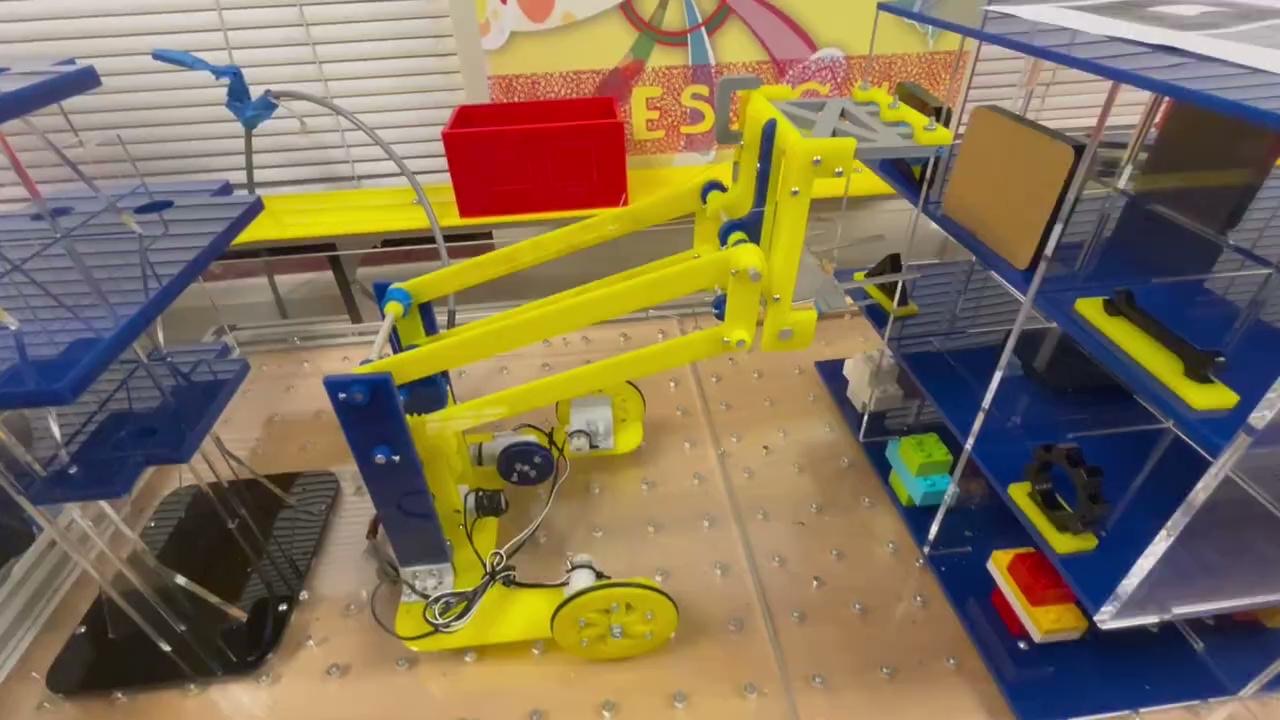
- A reliable 130 points per run, 175 at best, including a Lego on the top floor of Geisel.
- The judges’ Design and Innovation Award, in a field of 44 teams.
- Presented the design to 24 peers and 3 judges, professors and teaching assistants.